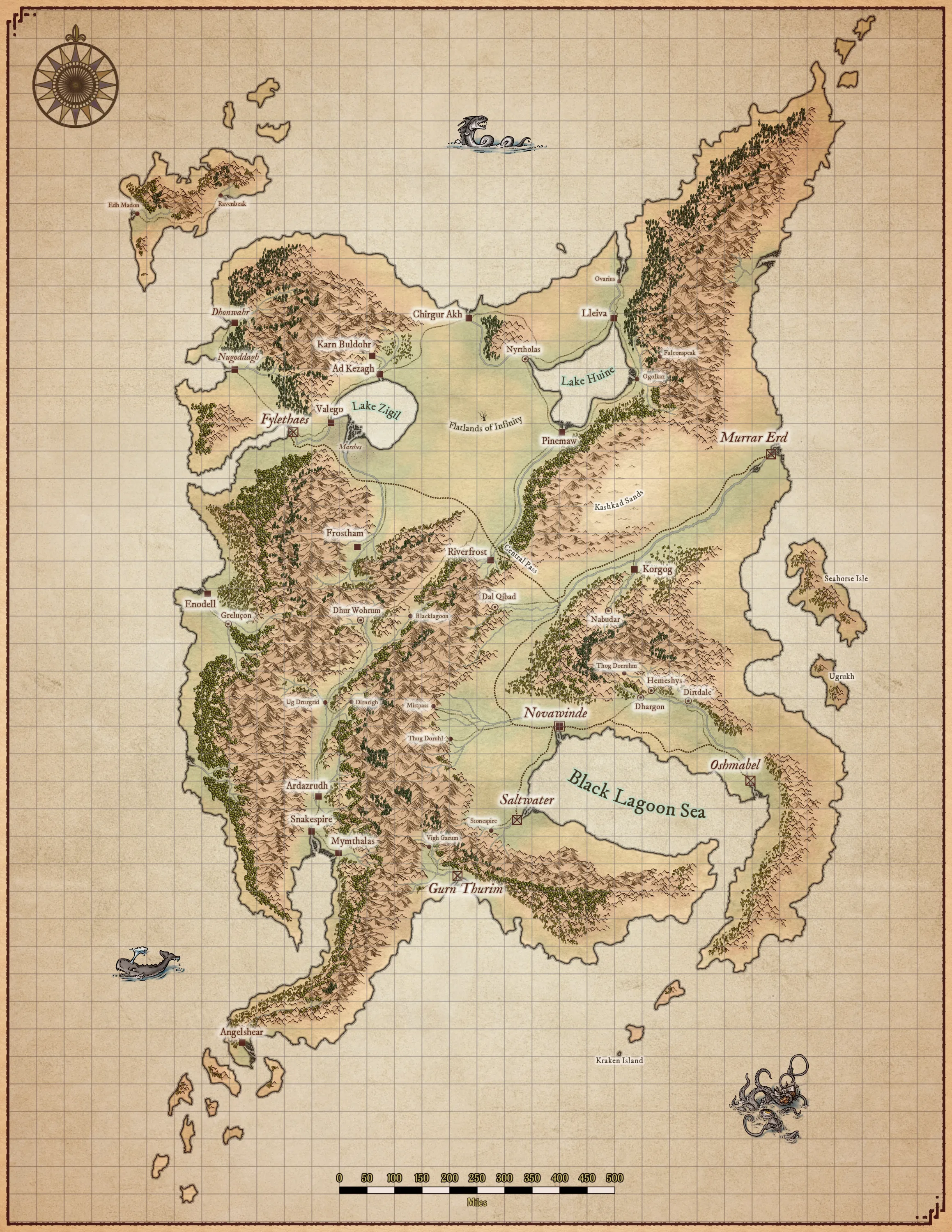
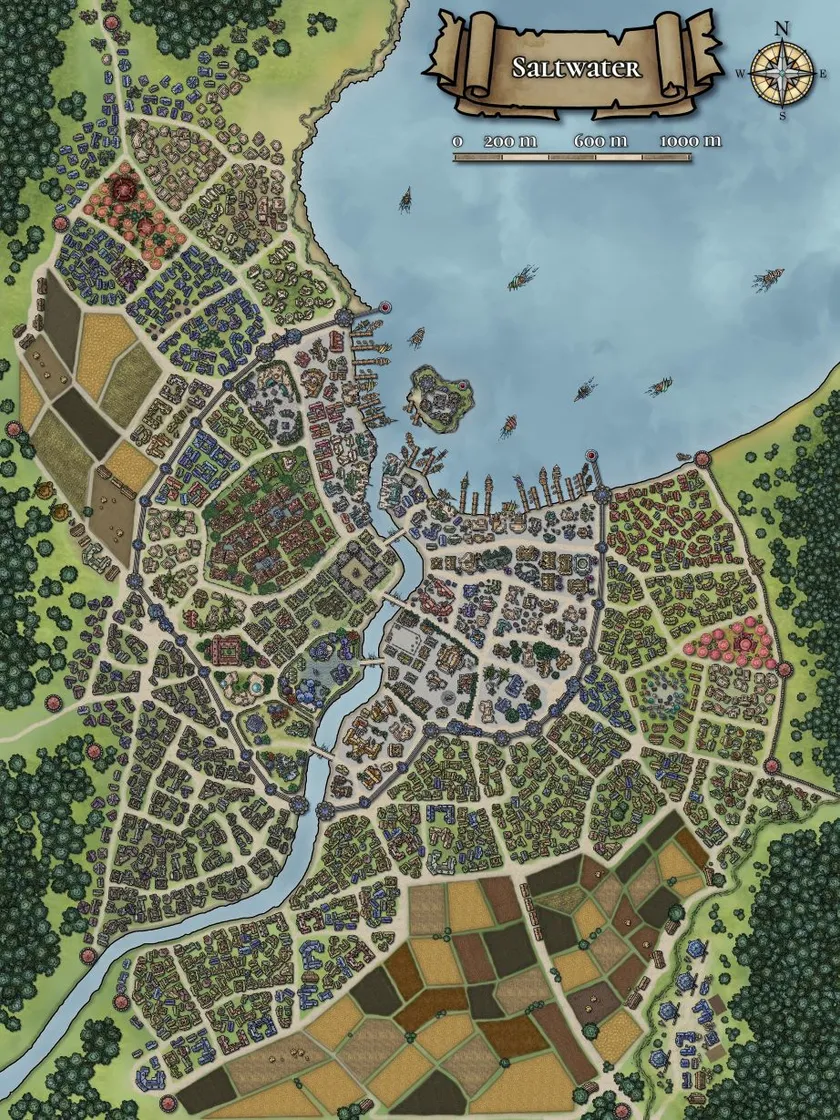
Saltwater, one of the four largest and most historically significant cities in Teliboria, is situated along the southwestern shores of the Black Lagoon Sea.
Demographics
With a dominant human population, the city is a hub of significant blue-water port facilities and has earned a reputation as the cultural heart of Teliboria, particularly known for its flourishing arts scene. The city’s total resident population stands at approximately 16,200.
Each year, Saltwater attracts around 8,000 visitors, drawn for various reasons:
- Settlers and adventurers aiming to explore the southwestern and western regions of the continent.
- Art enthusiasts from across Teliboria, flocking to the city for its renowned annual cultural events and exhibitions.
- Merchants and artisans who contribute to and benefit from the city’s dynamic and prosperous commercial landscape.
Saltwater distinguishes itself as one of Teliboria’s most cosmopolitan cities, celebrated for its diversity and inclusiveness. The city’s population primarily comprises humans, who are central to its demographic structure. Dwarves and elves also form significant parts of the resident society, each adding to the city’s cultural depth and social dynamics.
A smaller yet influential Orcish community contributes to the city’s eclectic atmosphere. Saltwater is a hub where various races from the Old World seamlessly blend, fostering a vibrant, multicultural environment. The city’s harmonious diversity is a testament to its welcoming nature and the capacity of its residents to integrate varied cultural backgrounds.
Gnomes hold a prominent position in Saltwater, renowned for their innovation and commercial expertise. Their sizable presence is second only to Novawindë in terms of absolute numbers. Integral to the city’s commercial and artisan sectors, gnomes are drawn to Saltwater’s thriving economy and the opportunities it presents for showcasing their skills and ingenuity.
This blend of cultures and traditions not only enriches Saltwater’s cultural tapestry but also profoundly affects the artistic scene in very creative ways. One of the key factors that elevated Saltwater to the artistic and cultural capital of Teliboria is the unique amalgamation of all the distinct artistic styles brought in by the different settler groups, creating a vibrant and original Teliborean artistic style.
This diversity had also an important impact on Saltwater’s defense and military capabilities. The city’s defense forces have integrated an array of techniques, tactics, and weaponry from the myriad cultures and races that constitute its population. This integration has resulted in a formidable and unique military presence.
Districts
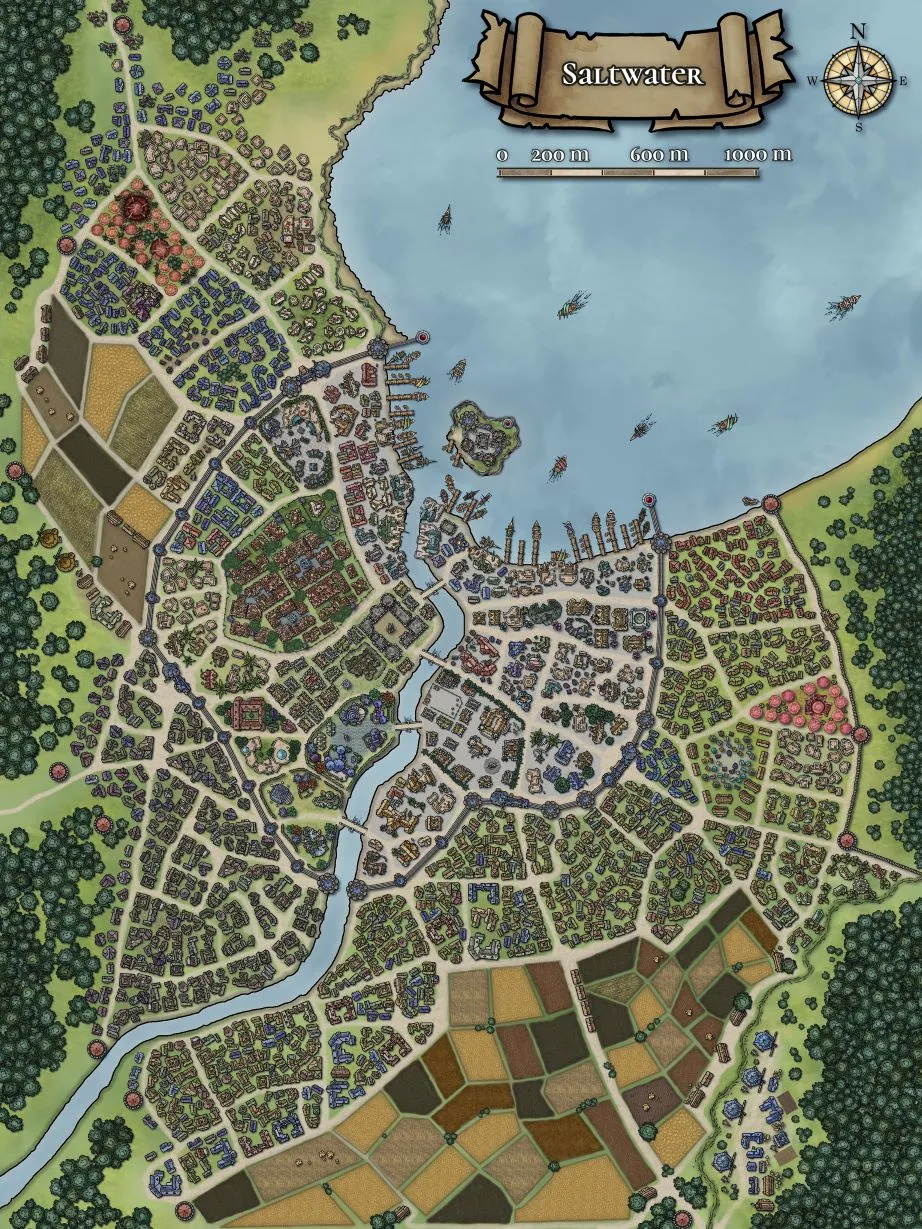
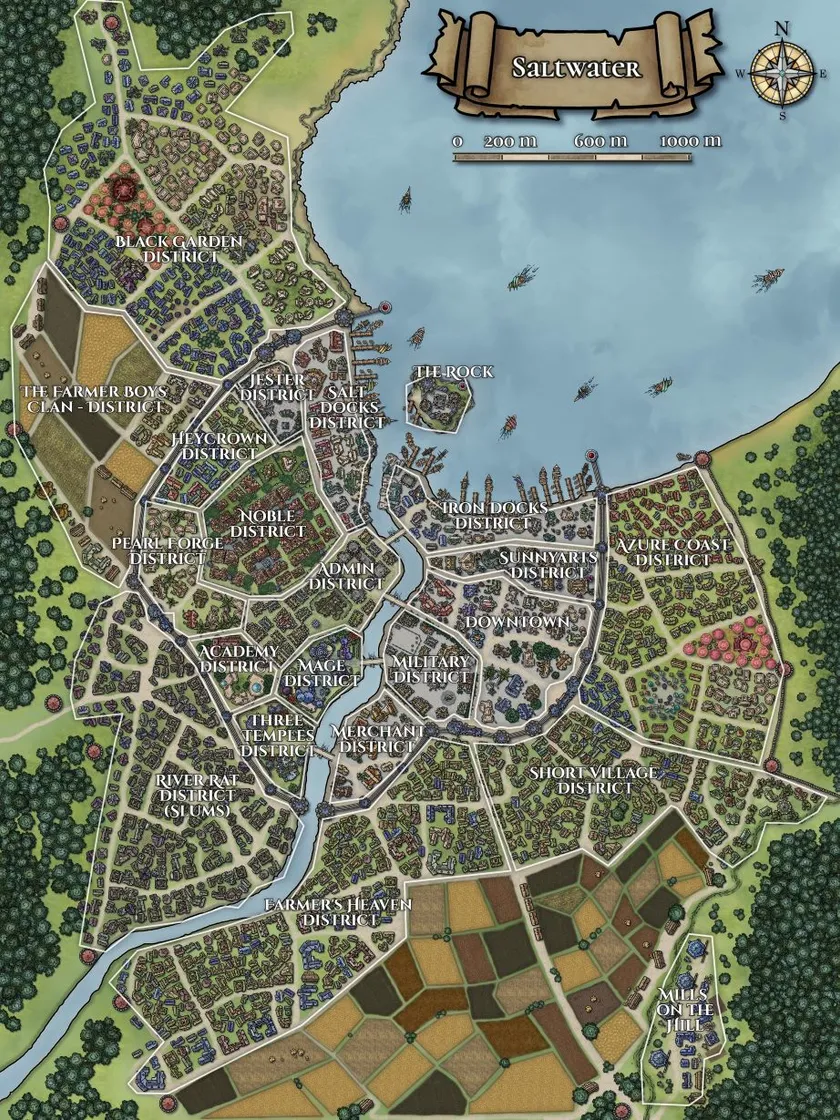
The urban tapestry of Saltwater is composed of 22 distinct districts, each showcasing a unique blend of styles and cultural influences. The city boasts 17 diverse Inns, offering accommodations that range from luxurious to modest, catering to the varied preferences of its visitors and residents alike. To ensure the safety and order of this bustling city, Saltwater is protected by a robust defense force, which includes a city guard and security personnel, totaling 525 dedicated members. This force plays a crucial role in maintaining the city’s reputation as a safe and welcoming destination for all who come to its shores.
District Details
Academy District: Prestigious for hosting two of Teliboria’s top universities, Gorik’s Engineering Institute and the Saltwater Academy of Sciences.
Admin District: Saltwater’s administrative hub and one of its oldest areas, featuring the City Hall, Inner Keep, and other fortified government buildings.
Azure Coast District: A historical district adjacent to the east wall and coastline, notable for being the first area where representatives of the four major Teliborian races formed a peaceful community after a bloody incident.
Black Garden District: Situated on the city’s northern edge. It is a diverse district that hosts distinct Human, Elven, Dwarven, and Orcish neighborhoods. It is renowned for housing the local Thieves Guild and is also the heart of the city’s leather working community.
Downtown: One of the city’s earliest settled areas, next to the East Gate, now serving as the city’s economic heart. It boasts ten high quality Inns, diverse vendors, and the Saltwater Artisans Guild.
Farmer’s Heaven District: Predominantly inhabited by the bulk of the Saltwater’s farming community, located outside the South Gate, between the river bank and the city’s main farmland.
Heycrown District: Among the city’s oldest districts within its walls, largely inhabited by descendants of the initial settlers.
Iron Docks District: One of the two port districts of the city housing docks, shipyards, various port facilities and services, three Inns and an Adventurers Guild.
Jester District: The city’s performing arts hub, vibrant with a theater, opera house, auditorium, and various related vendors and services.
Mage District: The center of Saltwater’s magical community, attracting adventurers and magic practitioners with its schools and specialized vendors.
Merchant District: The focal point for all merchant guilds, complemented by specialty vendors.
Military District: Headquarters of the Saltwater City Guard and Defense Force, featuring barracks, a Military Academy, a forge, training facilities, fortified warehouses, and a Fighter’s Guild.
Mills on the Hill: A small milling community operating four large windmills on the southeast hills, adjacent to the main farmland
Noble District: Saltwater’s most luxurious area, home to the city’s nobility and wealthier citizens.
Pearl Forge District: Established by dwarven settlers during the early settlement years, now with a mixed population and featuring six Inns next to the western gate.
River Rat District (Slums): Although less affluent, this district is rich in artistic heritage, often serving as a starting point for integration into Saltwater society.
Salt Docks District: The second port district, comprising docks, shipyards, various vendors, port services, the Saltwater fishing community, and the Portmaster’s building.
Short Village District: A recently developed and gentrified area replacing older slums, featuring the distinctively Elven neighborhood of Elderville.
Sunnyarts District: The cultural heart of fine arts in Saltwater, hosting exhibitions, art schools, museums, galleries, Teliboria’s largest library, and a unique artistic ambiance.
The Farmer Boys Clan District: Dominated by the Farmer Boys Clan, responsible for nearly 30% of Saltwater’s grain production. It is led by the influential Papa Bigheart, a prominent figure of the political scene and economic life of the city.
The Rock: An island fortress with a high-security prison, guarding the port’s entrance. It was fortified and its defensive capabilities were significantly augmented after Double Beard’s failed invasion.
Three Temple District: A religious landmark where different religions built and operate their temples side by side. Competition between them is mostly comical, rarely escalating to the point of real conflict with any significant impact of the society. However, the priests of this district offer critical services to the city and visitors, and they do have some influence in the political scene of Saltwater.
History
Saltwater is among the earliest settlements in Teliboria, initially established by a large group of human settlers and the elven crew of the ship that brought them to this new world. They set up their community alongside the river, in what is now known as the Iron Docks District.
Strategic location driving growth
The settlement’s growth was rapid, spurred by its close proximity to Novawindë, its safe natural harbor, and a wealth of local resources such as fertile soil, abundant forests, and a sea teeming with seafood. During the dawn of colonization, many ships bearing settlers from the Old World chose Saltwater over Novawindë, attracted by its milder micro-climate and viewing the burgeoning settlement as an ideal base for exploring southwestward, toward the enigmatic and mineral-rich mountain ranges.
The birth of a cultural hub
A pivotal moment in Saltwater’s history was the arrival of a thespian troupe, whose performances were an instant hit. People from across the region, including Novawindë, flocked to Saltwater to witness these acclaimed plays. This influx of visitors organically attracted more artists from both the Old and New Worlds, cementing Saltwater’s reputation as Teliboria’s cultural heart. The Sunnyarts District was established early on, followed by the Jester District, enhancing the city’s appeal to both tourists and settlers.
Racial conflict leading to harmony
However, Saltwater’s history wasn’t without conflict. A notable incident involved a clash between hot-headed dwarven settlers and a group of orcish adventurers at an outdoor flea market just outside the town’s walls (Saltwater has not grown to a city size yet). The situation escalated when elven hunters got involved in the brawl against the dwarves, and a detachment of human guards intervened, narrowly averting a full-scale racial battle. This skirmish resulted in significant property damage and loss of life.
In response, the Saltwater government seized the opportunity to foster a more inclusive culture, aimed at protecting both its commercial prosperity and flourishing artistic community. As a symbolic gesture, the flea market was renamed the ‘Friendship Market,’ evolving into a vast bazaar encircled by what are now known as the Dwarven, Elven, Orcish, and Human Delegation Neighborhoods. Though these neighborhoods initially reflected their namesakes, they have since become culturally and racially mixed.
Visitors to Saltwater can learn about the city’s rich early history through conversations with local residents or by visiting the public library, where tales of the past are preserved for future generations. You can use such historical events as starters for various quests in Saltwater, related to this period, conflict, and evolution of the city.
Economy
The city’s economy is founded on five key pillars:
- Art and culture-related products and services.
- Education and vocational training.
- Port and commercial activities.
- Shipbuilding and related services.
- Food production.
Culture, Art, and Education
Saltwater, the cultural hub of Teliboria, dedicates an entire district to the fine arts, with a second more contemporary district focusing on theater, music, and performing arts in general. The city is home to the continent’s largest library and attracts both renowned and emerging writers from regions of the Old World and across Teliboria.
The vibrant cultural scene, along with the city’s growing population and commercial expansion, has spurred the establishment of educational and vocational institutions. Saltwater boasts two universities and several professional schools governed by various guilds, plus numerous art schools centered around prominent local artists.
This robust combination of culture, art, education, and recreation has made Saltwater a prime destination, drawing more visitors than any other location on the continent. This influx significantly contributes to the city’s economic and cultural growth.
Ports, Shipyard, Commerce and Trade
Saltwater’s two ports, each featuring several renowned shipyards, attract clients from across the continent, making shipyard services a major part of the city’s economic success. The city is a critical node for commercial sea routes, augmented by river and land connections to the capital and beyond.
Saltwater’s vibrant economy thrives on key exports such as art, shipbuilding and repair services, timber, seafood, and agricultural products. The city primarily imports trade goods, luxury items, livestock, building materials, and ice, the latter mostly sourced from Stonespire via the river. Saltwater’s rapid expansion, rising affluence, and cultural renaissance have spurred a growing demand for luxury and specialty items. This boom has drawn a diverse array of merchants from across Teliboria and the Old World, ranging from reputable traders to opportunistic dealers and even fraudsters.
Agriculture and Food Production
Saltwater is not only self-sufficient in food production but also generates a surplus in grain, seafood, vegetables, and fruits, mainly exporting to southern Teliboria. The economic boom has increased demand for exotic and specialty foods, which the city imports.
The region’s fertile soil, abundant seafood, and thriving game populations have made agricultural and food production professions highly profitable, leading to the organic growth of entire districts focused on these industries.
Social Layering, Conflict and Factions
Saltwater’s society is distinctly layered, with a divide between the cultured, educated elite and the food production professionals (farmers, hunters, fishermen, etc.). Members of the former primarily reside in the city center and engage heavily in cultural and artistic activities, while members of the latter are situated near the outskirts, close to food production areas. These two are the dominant political factions with the level of influence and power to almost fully control the government of the city. There is almost constantly political friction between them, until some existential threat to the city unites them. This ongoing conflict occasionally allows smaller groups and factions to gain ephemeral increased influence, playing the role of a catalyst or the balancing factor during specific conflicts.
Government
The city adopted a form of unique representative government. Districts elect representatives based on a combined score of their population and their impact on the city’s prosperity. The formula is designed by a committee of scholars from both Saltwater Universities and the faculty of the Newmoon Academy of Magic. Surprisingly, despite the ongoing rivalry between the dominant factions, this electoral formula remains unchallenged by all political factions. The resulting Saltwater House of Representatives elects a Governor with a five year tenure. All major leadership positions (Military Commander, Chief Judge, Port-master, etc) are appointed by the Governor and approved by the House.While the system is generally efficient and has supported the city’s rapid growth, cases of political corruption and escalating conflict that harms the city are not uncommon.
Crime and the Underworld – Faction Conflict
Saltwater’s diversity extends to its organized crime scene too. The city’s underworld is a complex network of crime groups of all sizes, dominated by three major syndicates. These organizations, while often locked in a fierce power struggle, occasionally maintain a fragile equilibrium. Each syndicate not only wields considerable influence in specific areas but also has a number of smaller factions and groups operating under its umbrella as vassals or proxies. Currently, these are the three major underworld factions:

The Azure Serpents:
Base of Operations: Azure Coast District
Relations: Mortal enemies of the Iron Grasp Syndicate
Backstory: The Azure Serpents, named after the district they control, are known for their dominance over maritime smuggling and illicit sea trade. Originating from humble beginnings as a group of disgruntled dockworkers and sailors, they evolved into a formidable criminal organization. They are experts in navigating the complex waterways of Saltwater and have a reputation for ruthless efficiency. Their influence frequently extends beyond the city, reaching distant shores and deep into the heart of the maritime underworld.

The Black Garden Shadows:
Base of Operations: Black Garden District
Relations: Tightly intertwined with the local thieves guild. They are known to have cooperated with the Azure Serpents against the Iron Grasp Syndicate.
Backstory: Nestled in the heart of the Black Garden District, the Shadows are the masters of espionage, black market dealings, and political manipulation. Their rise to power is shrouded in mystery and whispers of dark magic. The Shadows are not just criminals; they are puppeteers, influencing the city’s politics and economy from the shadows, whenever they find the opportunity. Their connection with the local thieves guild gives them an extensive network of spies and informants, making them a feared and respected force in the underworld.

The Iron Grasp Syndicate:
Base of Operations: Iron Docks District and Mills on the Hill, and currently expanding their influence to fully control all crime in the Salt Docks.
Relations: There is a rumor that this crime organization has connections to powerful politicians that have access to the current government. They despise the Azure Serpents and they would gladly eliminate both them and the Black Garden Shadows even if this required large scale bloody conflict.
Backstory: The Iron Grasp commands a significant presence in Saltwater’s more industrial sectors. With their roots in the Iron Docks District and Mills on the Hill, they initially formed as a protective league for workers but gradually morphed into a syndicate involved in racketeering, extortion, and illegal trades in industrial goods. Their influence is heavily felt in the labor market, and they are known to have a stranglehold over several worker unions and labor groups. The Iron Grasp is characterized by their raw physical power and unyielding control over the city’s industrial heartbeat.
Currently, the city enjoys a delicate peace between these organizations. Smaller factions within the city, such as those in the River Rat District (Slums) and the Merchant District, often find themselves caught in the crossfire of these giants. The complex interplay of power and influence among these syndicates shapes much of the city’s hidden narrative, impacting everything from street-level crime to high-stakes political maneuverings. Visiting adventurers have many opportunities to interact with members of these organizations and they can easily learn about them by engaging in conversation with all Innkeepers, store owners and guards.
Relations, Influence and Diplomatic Tensions
Saltwater stands as a major city within Teliboria, exerting its influence over surrounding smaller settlements. Renowned as a cultural hub, its reach extends across the continent, drawing tourists, artists, artisans, merchants, and adventurers from across Teliboria and even the distant Old World.
The city maintains and cultivates robust trade connections with all major cities and neighboring smaller settlements. A particularly strong bond exists with Snakespire, a town established by a group of settlers and explorers who originally hailed from Saltwater. This connection has fostered sustained growth for the town and a vibrant cultural exchange, further cementing Saltwater’s role as a regional leader.
In the continent’s political arena, the Saltwater delegation to the Teliborean House of Representatives maintains a close alliance with representatives from the City of Oshmabel. While Saltwater strategically holds a non-aggressive posture and avoids direct feuds with other cities and smaller settlements, it finds itself in a competitive stance with most other major political powers on the continent. These rivalries, though not hostile, are evident in endeavors ranging from trade to cultural dominance, reflecting the city’s ambitious nature and its drive to maintain a prominent position in Teliborean affairs.
This delicate balance of alliances and rivalries paints a picture of a city deeply intertwined in the complex tapestry of Teliborean politics, yet standing firm in its cultural and economic stature, extended influence and regional power.
Connections and Travel Times
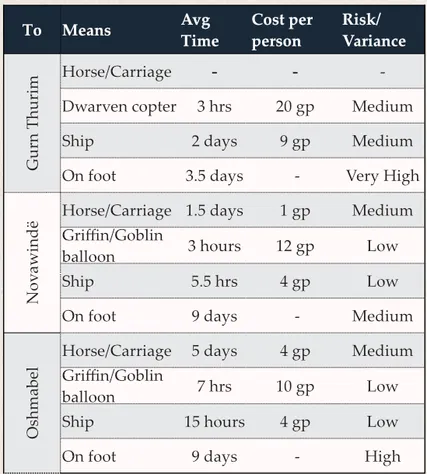
Saltwater, a coastal city, hosts a vast port equipped to accommodate all types of vessels, from shipping boats to blue water ships. It stands as one of the primary gateways to Teliboria for those visiting the continent by sea. The city offers regular maritime connections to all major Teliborean settlements with ports of any size. From Saltwater, ships depart at least weekly, often connecting through major cities such as Novawindë, Oshmabel, or Gurn Thurim. Notably, daily routes are established to Novawindë and Oshmabel, while thrice-weekly services are available to Gurn Thurim.
The principal northbound road from Saltwater leads directly to Novawindë, ensuring a steady bidirectional flow of trade and travel. Roads branching westward and southward from Saltwater facilitate access to various settlements in the broader regional vicinity. The westbound route leads to the small hamlet of Stonespire, and extends over the rugged mountainous terrain turning in a rough path, and passes through the hamlet of Vigh Garum, before reaching Gurn Thurim. These well-traveled roads play a crucial role in connecting Saltwater with the surrounding region by land.
Saltwater does not have a Griffin Den or Airship port, so travel by air is not common. There are, however, air transport services from other cities that can be booked and opportunistically used. Magic transportation is also rare but not unheard of, you just need to find the right connection.
The table below presents the average travel time, monetary cost, and associated risk for different types of travel from Saltwater to the three closer cities and vice versa.